

My face lit up as we entered the room full of glittery drag queens prancing around the stage, singing cheesy, campy songs. Sally Struthers was relaxing in the audience after her performance at the local theater (don’t worry, we got a photo with her); dozens of queers were laughing and holding hands and flirting and drinking. It was our first time at a gay bar since the shooting in Orlando and we felt at home. My partner and I have been shaken up after recent events and were thrilled to be surrounded by “family.” My heart was soaring as we arrived on the dance floor full of gay, lesbian, bisexual, transgender and gender non-conforming folks. We felt free in our bodies. We felt safe as a queer couple. I looked around the room and saw beautiful loving souls celebrating life, celebrating love.

So, it surprised me when tears suddenly came rolling down my face. In that moment I truly, deeply knew what it meant to say, “We Are Orlando.” This tragedy could have happened anywhere at any time. Anyone could have been the victims. I hugged my partner close and sobbed on her shoulder. “This could have been us,” I thought.
As we left the nightclub that evening, I grabbed my sweetie’s hand tight.
That night I felt heartbreak and pain, but it felt good to be with my community. And while I didn’t feel safe, exactly, I felt at home with my people. Happy.
Like everyone I know, I’d been shattered by the shootings at Pulse nightclub in Orlando. Like everyone in my community, I voiced my outrage, marched, cried. Being surrounded by my queer community and loving allies filled me with hope and connection. Connection to everyone around me. Connection to the Source of Healing.
Only days later, the world was rocked by violence, once again. Only this time it wasn’t my people. This time, black men were killed in the streets. This time felt different. While I grieved with my Black friends and community, this wasn’t my community. This was not my family. I cried tears for those who suffered from trauma, who were scared, who were victims of individual and institutionalized White Supremacy.
My heart sank when I learned of the retaliation attacks against police officers. My head has been spinning. The world I live in has been feeling shattered, broken and in need of mending.
It’s been a painful month.
And it’s easy to feel powerless. Scared. Angry. It’s easy to point fingers and blame and stomp and run away.
Part of me wants to run and hide and ignore the world around me and wrap myself up in the safety of my White Privilege. Wouldn’t that be easy? When I drive down the street, I don’t have to worry about being pulled over. When I peruse through the grocery store, no one assumes that I am shoplifting as I carefully place produce into my canvas shopping bags. I don’t worry for my brother’s safety when he is out in the world. I’m not fearful for my nephew’s life. It would be so easy, so simple to just check out and ignore the horrific news stories and be silent.
And part of me wants to hide in my femme, cis-gendered privilege. I can easily pass as a straight woman, avoid gay bars, use the women’s bathroom without being questioned or harassed and feel “safe.”
But I can’t hide behind my many layers of privilege. I can’t just run away. The tug is too strong. As a Jew, as a queer female identified cis-woman, as a feminist, as a white person and as a rabbi, I know that it is my obligation, my duty and my responsibility to work toward radical inclusion and social justice. It is my duty to work toward tikkun olam, healing the world.
Today, I choose to be loud. To be a part of the solution. To take a stand.
And this is complicated. What does it mean to be an advocate for the queer community, a group of people of whom I am a part? My people. My precious loved ones.
And what does it mean to be an advocate for the Black community, a group of people of whom I am not a part? My friends. My allies. My precious loved ones.
How can I use my power and privilege to create change in the world? Not as a savior, not as a hero, but as an ally. As a fellow human being.
Today, I choose to take action. Today, I choose to:
* Educate myself and my community about racism, about micro-aggressions, about White Supremacy and about White Privilege. About homophobia, transphobia and the bathroom laws.
* Donate to advocacy groups like Black Lives Matter, Atlanta Movement for Black Lives Reparations Fund, Help Queer&Trans Women and Femmes of Color Heal, SOJOURN (Southern Jewish Resource Network for Gender and Sexual Diversity), Georgia Equality and Equality Federation.
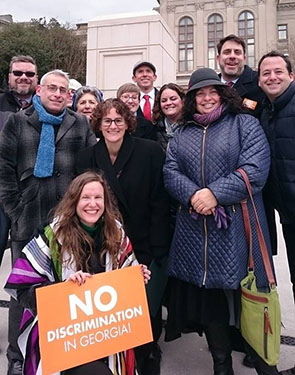
* Participate in rallies, protests, marches, vigils and spiritual gatherings.
* Volunteer to engage local residents in community conversations about why updating our non-discrimination laws to include gay and transgender people is vital.
Today, I will challenge narratives. I will listen actively. I will love deeply. In the words of Abraham Joshua Heshel, today I will “pray with my feet.”

